

Antigua
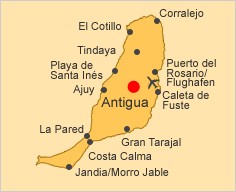
You could say that Antigua is lying exactly in the middle of the island of Fuerteventura. The FV20, that joins the island's centre with the northern and southern part, runs through Antigua. Antigua is the capital of the district "Antigua".
Information about the town of Antigua
The town with about 2,100 inhabitants is part of the municipal district of Antigua. The city is not a touristic centre but in Antigua itself - and especially in the beautyful surrounding - are magnificent accomodations. The landscape around Antigua is very colourful (in comparison with other places on Fuerteventura) . The reddish brown soil is a beautyful contrast to the green palm trees.

entry to the town of Antigua

landscape around Antigua on Fuerteventura

administration building of Antigua
There are many shopping facilities in Antigua, compared to other island cities that are not very touristic. For example bakeries, a big supermarket and petrol stations. There are also many restaurants and bars, a bank with a cashmachine, a travel agency, a post office, a keep-fit trail for adults and of course a playground for kids.

square with a café in Antigua

post office in Antigua

keep-fit trail for adults in Antigua

playgrounds for kids in Antigua
Outside the church (Nuestra Senora de la Antigua) is a nicely arranged square with lots of palm trees. Antigua also has a library and a well designed mill museum with a shop for craftwork.

church in Antigua

church in Antigua

square outside the church in Antigua

library in Antigua

mill museum in Antigua

Antigua

old villa in Antigua

Antigua

street scene of Antigua

street scene of Antigua
The nearest tourist centre is Caleta de Fuste. More detailled information about the town and the beach of Caleta de Fuste can be found on our websites: -> town of Caleta de Fuste oder -> beach Caleta de Fuste
bus/taxi
There also is a bus stop. Schedules can be found in island magazines or by asking the bus driver.
historic information
During the 15th century many farmers came to Antigua, one of the oldest settlements on the island, to sow and harvest from the fertile soil. Only in 1560 the farmers settled down permanently and soon later the entire south of the island joined Antigua. In the 19th century Antigua became the island's capital.